


Cross-functional buying of consulting: Growth that’s hidden in plain sight
The question we’re most frequently asked today is: “Who’s buying what?”
Our research consistently shows that clients expect their use of consulting and other professional services to grow, yet firms are struggling to locate that growth. Growth opportunities that are obvious—namely, technology—are ferociously competitive, more so now that doubts about the enterprise-wide value of AI are growing. Opportunities that are underserved—such as the middle market—may be attractive but have operational drawbacks (price sensitivity, for example). But there are some, frequently overlooked, opportunities that come from challenging the way we see the market.
The drivers of change
Ten years ago almost all consulting and professional services were bought at the functional level, by specific functional heads who were focused on fixing or improving the organisations they ran. If these departmental heads tried to do more, to buy services beyond the accepted remit of their role, arguments ensued. If a COO tried to buy technology, they would incur the wrath of the CIO—and, for that matter, that of the CFO looking to control spending. Functional heads still buy a lot of services, but CxOs and senior people with cross-functional roles (e.g., directors of transformation) are now the bigger spenders.
So, why is spending shifting away from departmental heads? There are three reasons:
1) Complexity:
Clients are dealing with far more complex external and internal problems than a decade ago, so the solutions have to be multifaceted. No single functional leader can have an impact if they only act autonomously.
2) Technology:
Digital transformation began a trend that the adoption of AI has amplified—the assumption that no change or improvement is possible without technology. The rogue COO who circumvented the IT department became not just the norm, but the role model.
3) Money:
Almost 90% of the clients we survey say their technology spend has increased in the last year and a similar proportion say it will increase again in the coming one. That’s not surprising—two thirds of clients say they need to update their technology as soon as possible if they’re to survive the increasing number of competitive threats. None of this comes cheap and the more organisations spend on technology, the more people are involved in making decisions about using external support. CxOs may have previously felt comfortable building up their own pots of money, but they’re not going to sign off expenditure on the scale now required without the agreement of their colleagues. The risks are simply too great.
How is this now playing out in practice?
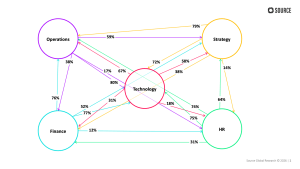
The picture is inherently complex, so we’ve focused our analysis on five functions: finance, HR, operations, strategy, and technology. The chart below shows the proportion of the clients in each function that are buying services usually associated with the other functions. For example, 79% of strategy executives buy operations-related services, while 59% of operations executives buy strategy-related services.
The tangled web: Clients buy different types of services.
Data source: Market Trends survey 2026
Some services are more pervasive than others: On average, there’s a 74% chance that clients outside the technology function are buying technology-related services and a 74% chance that those outside the operations function are buying operations-related services. At the other end of the scale, only 15% of people outside the HR function are, on average, buying HR-related services. Some of the discrepancy may stem from terminology: “Technology” and “operations” cover a growing multitude of activities, whereas “HR” feels like an increasingly narrowly defined activity that is largely only of interest to HR professionals. In our interviews with clients, we hear a lot about “people challenges”, but these aren’t referred to as HR issues.
Then there are some less obvious findings. The relationship between the operations and technology functions is no surprise: Eighty percent of operations executives buy technology-related services and 67% of technology executives buy operations-related services. But this data also highlights the changing role of the strategy function. Historically suspected of working in isolation, there’s a 79% chance that today’s strategy clients are buying operations support and a 72% chance they’re buying technology work. The data also demonstrates how dangerous assumptions can be. If a firm is to only focus on selling technology services to the technology function, they would almost certainly be missing opportunities to sell technology to other functions. They would also be missing out on opportunities to sell the technology function other services: Sixty-seven percent of technology clients are also buying operations-related work and 58% are buying strategy-related work.
The implications for consulting and professional services firms are clear: Don’t assume that your clients are only interested in services that relate to their function.