


Demand for risk-related services is growing. But how could firms accelerate this trend?
There are opportunities for growth in the professional services market today, with financial services and cybersecurity having previously featured in this ongoing series. But firms need to act decisively to take their share, and here we explain how they can do this in the risk services market.
The global risk market—with its services ranging from the strategic response to geoeconomic crises to day-to-day risk management and compliance—was worth US$196bn in 2025, meaning it’s the third busiest professional services market after legal services and technology. Since the post-pandemic market peak, demand for risk services has consistently outperformed the overall market—and we’re forecasting that it will grow even more quickly against the average in the next two to three years.
No one would question why risk has become a more important issue for client organisations. Continuing war in the Gulf region threatens to raise costs further; changing tariffs mean that organisations with extensive international operations need to change their business models if they’re going to have a secure future. Leadership teams don’t have the data they need and are being slow respond to new issues, and many organisations simply don’t know what to do.
But the puzzle of this market is why demand is not growing more quickly. Surely, in these circumstances, it should be exploding? But it isn’t.
The constraints on growth
Our research suggests that there are three main, interrelated barriers to growth in the risk services market.
An unrecognised need for change in the risk function: Risk professionals’ priorities tend to focus on internal problems (new skills and technology to cope with new risk issues), but other executives are looking for a more forward-thinking risk function that’s capable of planning better for future crises—one that’s capable of helping organisations respond to geopolitical and economic turmoil. This means there are two distinct markets for risk services: Risk professionals will be continuing to buy the type of services and support they’ve used over the last decade, but senior executives in other functions want transformational change.
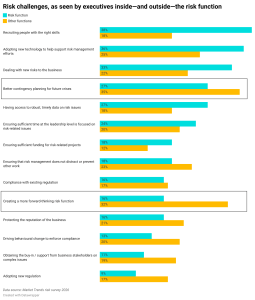
Lack of sustained attention: Divergence in the needs of risk and non-risk clients is resolvable if there’s a clear steer from the top of organisations. But over the last two years, the extent to which risk has been the subject of leadership conversations has yo-yoed, up one quarter, down the next. The root cause of this is the number of competing priorities leadership teams now have. In our survey of almost 3,000 senior executives this year, we found that only a fifth would say that risk is one of the top three topics when their executive team gets together. Technology, especially AI, has absorbed much more attention, eclipsing the time—and money—left for other issues.
A shift to in-house resourcing: One of the most important questions we ask clients is which consulting services they’re most—and least—likely to buy. This gives us a sense of the relative importance of different client needs in a market that’s always shades of grey, never black and white. Last year, risk services were ranked 10th in terms of being the most likely service clients would buy, and the proportion of people who planned to use external support was slightly higher than those who said they’d prefer to keep this type of work in-house. This year, risk services are ranked eighth, but there’s now an even balance between clients who plan to bring in outside support and those that expect to do this work themselves. In other words, more organisations are investing in risk-related activities, but more also expect to do the work internally.
What to do?
If firms can solve these three problems, then the brakes will come off growth rates across the risk services market.
- Build the business case for change within the risk function: Unsurprisingly, the primary relationships a risk services firm has are with people in the risk function—these have, after all, traditionally been the main budget holders and therefore the biggest source of new work. While buying patterns may be shifting, with more people outside the risk function buying risk-related work, a risk firm (or practice) can’t ignore the hands that have fed it for decades. At the same time, the more it sticks with selling its traditional, inward-facing offerings, the less credible it will be with buyers outside the risk function. This means building the case for change with those inside the function—educating and coaching senior risk professionals to shift their focus towards more transformational change, not ignoring or bypassing them.
- Keep the attention of senior leadership teams: Getting clients’ attention isn’t the problem, but having sustained conversations about risk at the top of organisations is. What’s needed is a continuous programme of one-to-one, face-to-face conversations around strategic risk challenges between senior clients outside the risk function and partners who understand the acute business challenges of risk in the current environment. And this will require a continuous stream of client data to share that demonstrates the scale of the change in thinking that’s required—and the benefits of doing so.
- Demonstrate how your expertise is evolving: It’s easy in a mature market, such as risk services, for clients to assume there are plenty of risk professionals they can recruit and bring in-house, rather than go through the hassle and expense of using outside support. But what will matter here is to demonstrate that exceptional geopolitical and economic challenges need new skills and tools—and the ability to get the best from both. That’s something that an external firm, with its wealth of expertise, greater resources, and externally focused perspective will be better able to bring to the table.
But a word of warning: Doing just two of the above probably won’t work. You have to do all three.
What can firms do next?
The risk market is performing well in challenging circumstances. But, with a bit of help from the supply side, it could be growing faster. Source has an immense amount of data about risk services and the wider professional services market, which can help you size the potential market for your firm and talk authoritatively to clients about where you can provide the support they need. Get in touch if you’d like to explore this data further.
Our annual report on trends in the risk & cybersecurity services market will also go live later this month, let us know if you’d like to be alerted.