

Looking beyond tech: The pressures for change will drive diversity of demand from consulting clients
Substantial, long-lasting change in the external environment is one of the underlying drivers of growth in demand for consulting and professional services. Clients’ response over the last five years has almost wholly been focused on technology. But our most recent data suggests that clients are looking for a less monolithic approach.
There are four fundamental factors that influence growth in the consulting and professional services market: A shortage of skilled labour (expertise is still the top reason why organisations bring consultants in to help them in the first place); the need to deploy new technology (three quarters of organisations say that they need to update their technology as soon as possible if they’re going to survive); affordability, i.e. the extent to which organisations have budgets to pay for the support they need; and change. Although all four are important drivers of consulting growth, the last—change—comes first both in terms of timing and importance. Without the pressure to change, organisations defer investment or don’t invest at all. Changes in consumer behaviour means that organisations have to develop new products and services. Regulatory change forces them to develop new systems and processes. Cost pressure drives innovation. If change is too small or too temporary, then clients don’t react. Too much, and they can be paralysed with fear.
In this update, we’ll explore what our latest data tells us about clients’ perceptions of change and the implications that has for consulting and professional services firms.
Perceptions of change
Fifty-six percent of clients surveyed in the latest edition of our Quarterly Client Survey think the pressure to change in their organisation is greater today than it was during the pandemic. What our interviewees tell us is that this perception stems from their sense that, in 2020, they had a single issue to focus on: ensuring their organisations could recover when it was safe to do so. Today, senior executives are faced with a panoply of issues. Although technology, especially AI, is perceived to be the greatest driver of change, economic and political dynamics, customers, and competitors are also creating significant pressure.
Furthermore, over 90% of clients believe they’re likely to face new, very disruptive challenges in the next three years, and 80% think that the pressures on their organisations will increase.
More eggs in more baskets
For the last five years, faced with extreme pressures that are far outside senior executives’ control, almost all hopes have been pinned on technology. Indeed, ChatGPT’s arrival couldn’t have been more opportune: At a time when organisations were casting around for possible solutions to rapidly rising costs, GenAI promised significant, apparently instant cost savings. Of course, since then, our assumptions about how long it will take to realise the benefits of AI have become more measured. But the adoption of AI, combined with how to upgrade the technology and data infrastructure AI requires, continues to dominate the agenda of senior leadership teams. Digital transformation is still the number-one area where clients say they are making significant investment in the short term (with most spend falling in the next 18 months) and the application of AI comes second.
However, we also see signs that clients may be starting to think more broadly about how to respond to the challenges they face. Almost 40% of clients say they’ll have to change the strategic direction of their organisation, and almost as many say that they’ll have to innovate and grow their revenues.
But to see the importance of this, we need to segment the data further. The chart below compares clients’ perceptions of the source of change with their responses (excluding technology). What it suggests is that, if we look beyond technology-as-the-universal-panacea, three distinct strategies for dealing with the multiple pressures for change are emerging:
Mapping pressure for change against response to change
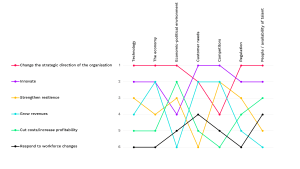
- Innovation & new direction: The biggest group of clients—those who see the pressure to adapt as coming from technology, economic factors, regulation or talent—think they’ll need to make far-reaching, strategic change if they’re going to respond effectively.
- Cost containment: Those who believe that the pressures they face are caused not simply by economic factors but by the general political climate also think a new strategic direction will be necessary but align this to cost reduction rather than innovation, perhaps because they expect further political shocks in the future.
- Growth: Unsurprisingly perhaps, clients who feel pressured to change for reasons specific to their business as opposed to the wider economy (changing consumer and/or competitor behaviour) see their response in terms of revenue-building innovation.
Be prepared
Technology will continue to be a critical way in which client organisations respond to the pressures they’re under. But this data suggests that technology by itself will not be sufficient and that clients are starting to look for a multidisciplinary approach, focusing on different outcomes: innovation, cost containment, or growth. Consulting and professional services firms should prepare for this shift.
What can firms do next?
To dive deeper into buyer trends, market sizing, and other drivers of consulting, speak to us about our two decades of ongoing research. We can help you build a clear picture of your clients’ consulting needs through in-depth surveys and direct conversations with decision makers.